

BP’s Architecture Overview #
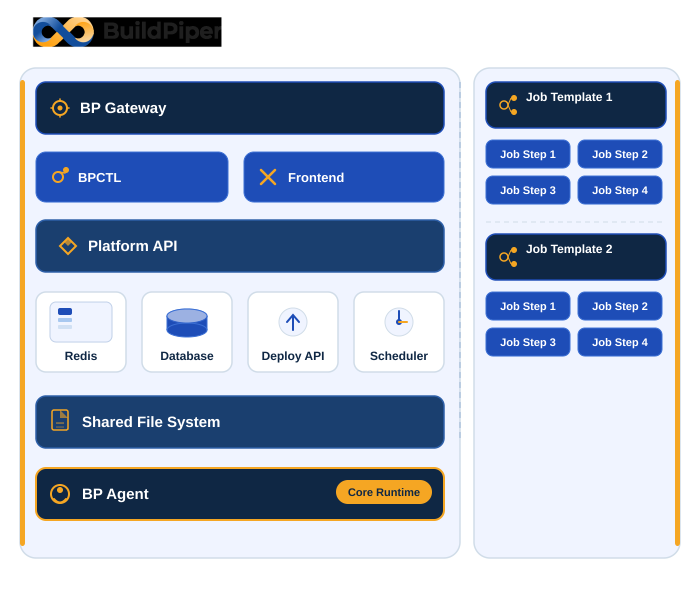
BuildPiper is built on a scalable, asynchronous, multi-component architecture. Each layer is designed for high availability, elastic scaling, and clean separation of concerns — from the gateway down to the BP Agent executor.
Architecture Components #
Each component in the BuildPiper platform plays a specific role in orchestrating the end-to-end software delivery lifecycle.
BP Gateway is the main entry point of the platform. It acts as a gateway within the product, efficiently distributing incoming network traffic across a group of servers supporting the platform. Once traffic crosses the BP Gateway, it then either reaches the Frontend (BuildPiper UI) or BPCTL.
This is a feature-rich, easy-to-use, highly intuitive user interface to leverage product functionalities. BuildPiper can be configured and configured Jobs can be triggered via the state-of-the-art user interface. This is the main customer-facing component — all user interactions happen via the Frontend.
BuildPiper provides a CLI to interact with BuildPiper’s Platform API. This CLI is called BPCTL. It works via Manifest files which can be applied via the bpctl apply command. BPCTL Manifest definition supports a wide variety of kinds to configure microservices and associated constructs. Almost anything that can be set up via the UI can also be set up via BPCTL.
BPCTL Documentation Links
The core of BuildPiper is the Platform API. It exposes the REST API via which the product can be configured, microservices can be set up, and Jobs can be triggered. Platform API is the central control plane which interacts with the Scheduler Engine, BP Agents, Deploy Agents, and MySQL database to orchestrate all platform functionalities.
Infrastructure Components #
Open-source, in-memory data store used as a cache layer for high-performance data retrieval.
v7.4.0
Primary MySQL database store — the persistent backbone for all platform configuration and state data.
MySQL v8.0.39
Schedules and manages all asynchronous tasks performed by the platform, ensuring ordered and timely execution.
The Deploy API supports the entire deployment process. It is designed to perform the following tasks:
All data regarding build, deployment, monitoring and more is stored in the Shared File System. Since the whole system is auto-scalable, keeping all platform elements in sync is critical. All components — the Platform API, Deploy API, BP Agent and others — are kept in sync through shared information via the Shared File System.
Core Runtime
BP Agent is the orchestrator which executes Jobs and Steps within the Job Template. BP Agent picks jobs from the Queue and executes them as per the availability of consumers.
BuildPiper is an out-of-the-box, ready-to-use platform that also offers complete flexibility to reconfigure its behaviour. This flexibility is enabled through its Job Template and Step Catalog framework.
📘 BuildPiper Documentation · Architecture Overview
Last updated: March 2026